Why Does the Green Electricity Tariff (GET) Sometimes Increase Electricity Costs in Malaysia?
May 31, 2026
Many companies subscribe to the Green Electricity Tariff (GET) programme with the expectation that renewable energy will eventually become more affordable than conventional electricity. However, some businesses were surprised to discover that their electricity bills became higher after subscribing to GET, especially between July 2025 and April 2026.
To understand why electricity cost is higher than non-subscriber, it is important to first understand how the GET programme works and how electricity pricing has changed in Malaysia.
What is the Green Electricity Tariff (GET)?
The Green Electricity Tariff (GET) is a voluntary programme introduced by Malaysia’s Ministry of Natural Resources and Environmental Sustainability (NRES). It is available to both domestic and non-domestic electricity consumers, allowing households and businesses to support renewable energy generation while reducing the carbon footprint associated with their electricity consumption.
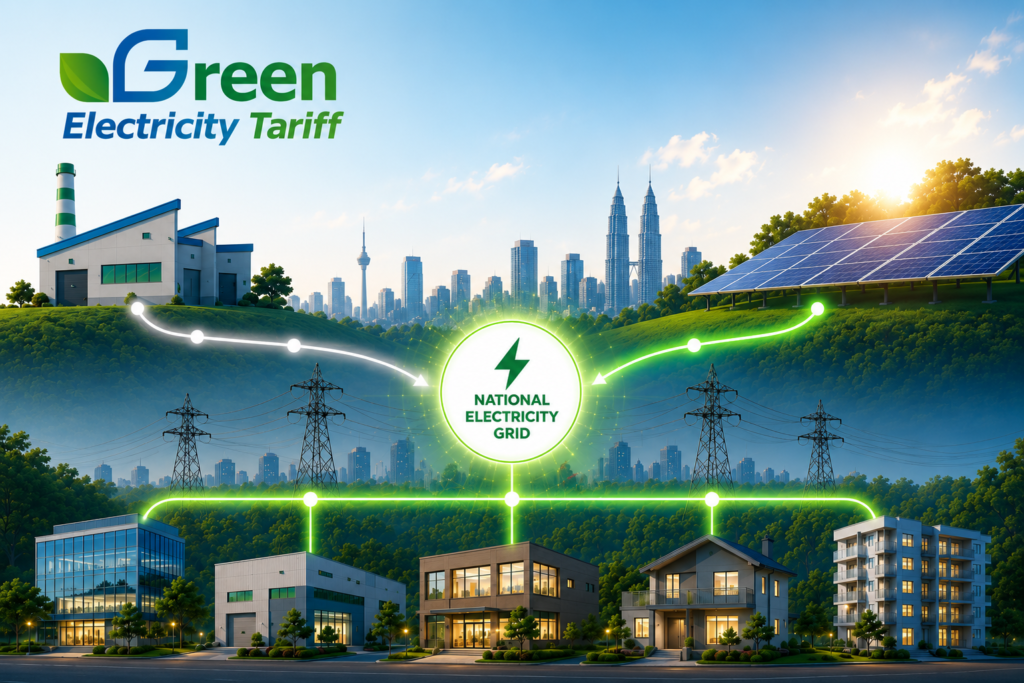
It is important to understand that subscribing to GET does not mean the electricity physically supplied to your facility comes directly from renewable energy sources. Malaysia operates a shared electricity grid where electricity generated from various sources is pooled together before being distributed to consumers.
In practice, GET subscribers are paying a premium to support the injection of additional renewable electricity into the national grid. No additional equipment or infrastructure is required at the subscriber’s premises.
Learn more about how the GET program works here: GET (Green Electricity Tariff) Program in Malaysia.
Changes in the GET Programme Through the Years
Since its introduction, the GET programme has undergone several significant changes.
1. Changes in GET Premium Fee
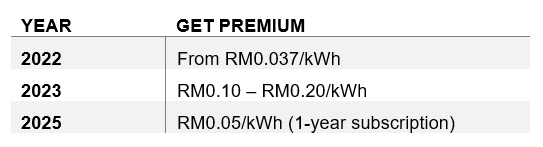
One of the most noticeable changes is the revision of GET premium fees. The minimum premium increased from RM0.037/kWh in 2022 to RM0.10–RM0.20/kWh in 2023 before being revised again to RM0.05/kWh under the 2025 one-year subscription package. The substantial increase in 2023 was largely attributed to investments required to strengthen and upgrade the electricity grid to support increasing renewable energy integration without affecting grid stability.
2. Increase in Subscription Quota
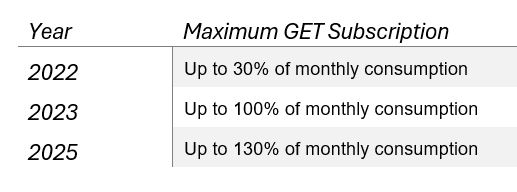
The subscription quota for businesses has also expanded significantly over time. In 2022, companies could subscribe to GET for up to 30% of their monthly electricity consumption. This limit was increased to 100% in 2023 and later to 130% in 2025. The higher subscription cap allows businesses to better manage fluctuations in electricity consumption while maintaining sufficient renewable energy certificates for reporting purposes.
3. Introduction of GET Greenpath
In August 2025, NRES introduced GET Greenpath, which allows tenants in commercial buildings to receive renewable energy certificates directly under their own organisation’s name, provided that the building owner participates in the programme. This development enables tenants to make renewable energy claims even when they do not own the electricity account.
4. Replacement of ICPT with AFA
Perhaps the most significant change affecting GET subscribers was not related to GET itself. In July 2025, Malaysia abolished the Imbalance Cost Pass-Through (ICPT) mechanism and replaced it with the Automatic Fuel Adjustment (AFA) mechanism.
Electricity consumers generally pay a base electricity tariff and a fuel cost adjustment. While the base tariff is relatively fixed, the adjustment reflects differences between the forecasted and actual fuel costs used for electricity generation.
Both ICPT and AFA serve this purpose. When actual fuel costs are lower than forecasted, consumers receive a rebate. When actual fuel costs are higher than forecasted, a surcharge may be imposed. This mechanism helps balance electricity affordability, fuel price volatility, and economic stability.
Under ICPT, fuel cost adjustments were reviewed every six months. Under AFA, adjustments are made more frequently to reflect actual fuel costs and market conditions. As a result, electricity bills now respond more dynamically to changes in global fuel prices and exchange rates.
Has GET Failed?
Since the introduction of AFA in July 2025, the mechanism provided rebates rather than surcharges until April 2026. This means electricity consumers received discounts because actual electricity generation costs were lower than the benchmark assumptions used in the tariff calculation.
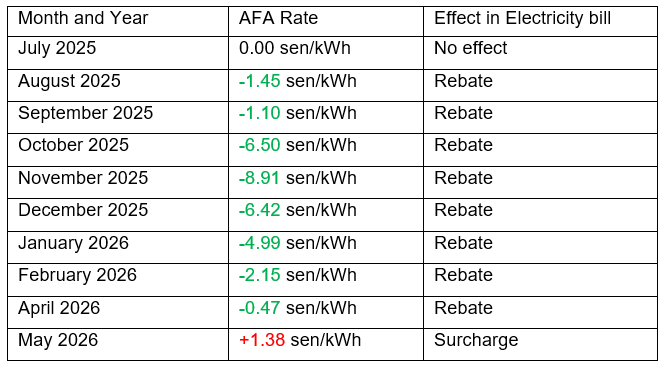
For example, the AFA rate in August 2025 was -1.45 sen/kWh. Assuming a factory consumes 100,000 kWh of electricity in a month, the factory would receive a rebate of RM1,450.
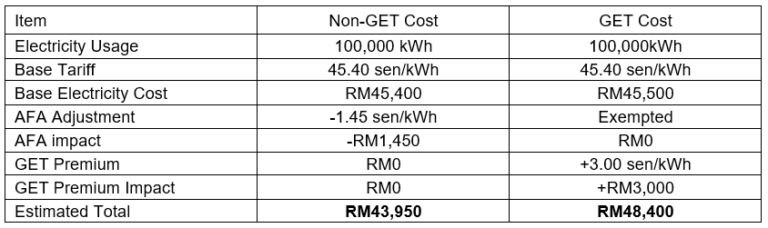
At the same time, the average base electricity tariff was approximately 45.40 sen/kWh. Therefore, a factory without a GET subscription would pay RM45,400 based on the base tariff but receive an AFA rebate of RM1,450. The final electricity bill would therefore be RM43,950.
For a GET subscriber, the situation is different. GET subscribers are exempted from AFA adjustments. While this protects them from future surcharges, it also means they do not benefit from rebates when AFA becomes negative. As a result, the same factory would still need to pay the full base electricity cost of RM45,400. In addition, the factory would need to pay the GET subscription fee, which was approximately 3 sen/kWh, equivalent to RM3,000 for 100,000 kWh of electricity consumption.
Consequently, the GET subscriber would pay approximately RM48,400 compared to RM43,950 for the non-GET subscriber, a difference of RM4,450.
At first glance, this may appear to suggest that the GET programme has failed. However, the higher cost was primarily driven by market conditions rather than weaknesses in the programme itself.
The AFA rebates between July 2025 and April 2026 were largely due to lower-than-expected fuel costs. Global coal prices had declined significantly from the levels assumed when electricity tariffs were established. For example, in August 2025, the tariff benchmark assumed a coal price of USD120 per ton while the actual market price was closer to USD95 per ton, electricity generation costs therefore is lower than expected. A stronger Malaysian Ringgit against the US Dollar also reduced the cost of imported fuel.
As a result, electricity consumers benefited from continuous AFA rebates throughout this period.
The situation changed in May 2026 when AFA recorded its first surcharge of +1.38 sen/kWh. Information regarding the monthly AFA rate can be obtained through the myTNB website.

Even so, a surcharge of 1.38 sen/kWh remains lower than the GET subscription fee of approximately 3 sen/kWh. Therefore, GET subscribers would still pay more than non-subscribers. In general, if the AFA surcharge remains below the GET premium, electricity bills for GET subscribers will continue to be higher than those of non-subscribers.
Is It Still Worth Going for GET?
The suitability of GET depends largely on the business context rather than the monthly electricity bill.
One factor often overlooked is fuel price risk. The introduction of AFA in July 2025 means electricity costs are now more closely linked to actual fuel prices and market conditions. While AFA remained in rebate territory between July 2025 and April 2026, future fuel prices remain uncertain. If global coal or natural gas prices increase significantly, AFA may record higher surcharges. Under such circumstances, GET subscribers are exempted from AFA and therefore less exposed to fuel-related electricity cost fluctuations.
GET may also be relevant for businesses that require renewable energy claims but have limited options for generating renewable energy on-site. This is particularly common among companies operating in rented premises, facilities with insufficient roof space for solar installation, or sites where technical or financial constraints make renewable energy projects impractical.
In addition, many multinational corporations, export-oriented manufacturers, and publicly listed companies are increasingly expected to demonstrate progress towards carbon reduction and renewable energy targets. Through the GET programme, subscribers receive Malaysia Renewable Energy Certificates (mRECs), which can be used to support renewable electricity claims for customer requirements, sustainability reporting, and ESG-related disclosures.
How ESG Tani Can Support Your Energy Transition and ESG Goals
ESG Tani supports organisations in assessing and implementing suitable renewable energy and carbon reduction initiatives through services such as:
-
Carbon footprint advisory – identifying key emission sources and opportunities to reduce Scope 1, Scope 2, and relevant Scope 3 emissions
-
Energy Attribute Certificate (EAC) strategy – providing guidance on renewable energy sourcing options, including mechanisms such as mREC and other internationally recognised certificates
By combining technical knowledge with practical industry experience, ESG Tani helps businesses adopt a structured approach towards decarbonisation, ensuring alignment with both local initiatives such as GET and global sustainability frameworks.
Want to learn how we can support your goals?
Explore more about our services here.
Let us walk the journey of responsible business with you.
Share the article on social media: